

TL;DR
- The Problem: Agents are the future, but they are notoriously prone to failures that are difficult to assess, especially when analyzing agent trajectories at scale. Silverstream, in its mission to build reliable enterprise-grade agents, faced a similar challenge while deploying web agents.
- The Solution: Silverstream has used Interpret AI’s model to analyze its agentic web data logs at scale. Our platform automatically clustered failure modes and found the root cause breakdown for each task.
- The Business Impact: By analyzing the root causes of agentic failures, Silverstream was able to achieve a success rate of 95% on public, third party agentic benchmarks and evolve from demo to providing reliable agentic infrastructure to real world customers.
The Problem: Why Do Agents Fail?
For business executives, the promise of autonomous agents is tantalizing: automated workflows, hyperpersonalization, and efficiency gains. The reality, however, is a landscape of error prone agents that fail when they touch the messy, unpredictable real world.
The challenge Silverstream faced is a problem of scale and observability: where did we fail and why? When an agent fails, it's one error in a sea of millions of interactions. Agent logs may show a "timeout" on one site and an "element not found" on another. Are these two unique bugs or two symptoms of one underlying failure pattern? This is known as the "black box" problem of agent deployment, and it's what separates a cool demo from a trusted, enterprise-ready product.
From Chasing Bugs to Clustering Failures
This is where our collaboration with Silverstream AI began. Silverstream’s mission is to provide the infrastructure for reliable autonomous agents. To do this, they needed to solve the "black box" problem at scale because traditional solutions like using human annotators or having engineers analyze failure logs wouldn’t be sustainable on a large number of agent trajectories.
Here’s how Silverstream reduced their agent failures to super-human reliability:
Step 1: Categorize & Ingest All Agent Trajectories
Silverstream fed thousands of multimodal logs (the “traces”) including agents’ screenshots, DOM snapshots, and text based actions directly into the Interpret AI platform. Silverstream also provided context for an ontology describing six common failure categories:
- Extraction: Did the agent see the webpage correctly?
- Capabilities: Did the agent reason about the next step properly?
- Action: Did the agent act appropriately?
- Stability: Did the browser/network remain stable or go down during agent engagement?
- Policy: Did the agent behave acceptably and within the parameters of the user spec?
- Access: Did the agent have adequate permissions to certain parts of information or the web?
In other words, an ontology is a set of instructions categorizing failure modes.
Step 2: Ontology assessment via Clustering
Once ingested, Interpret AI’s data engine automatically processed the stream of trajectories at scale, finding failures across millions of trajectories.
Rather than relying on manual labeling or ad-hoc heuristics for pattern matching, the platform utilizes latent embeddings and semantic clustering to analyze the full context of the failures, assessing the defined ontology using the visual state (screenshots) the structural state (DOM), and the agent's reasoning (text logs) of all agent trajectories.
During this process, our engine may detect traces that don’t fit any predefined ontology. This made Silverstream’s team aware of points that fell outside of their predefined scope. The result was that the ontology was edited to include meaningful failure modes that were missing and removed certain failure modes that were not representative of the actual traces.
Step 3: Root Cause Analysis (RCA) Report
Once the team felt confident about the ontology, they ran Interpret’s root cause analysis pipeline which assessed each trace for failures.
The Interpret AI system performed a holistic review of all these trajectories and generated a Root Cause Analysis report that outlines the distribution of failures across all the trajectories.
This process moved beyond simple log parsing and diagnosed the underlying failures at scale so that Silverstream could act immediately with these insights.
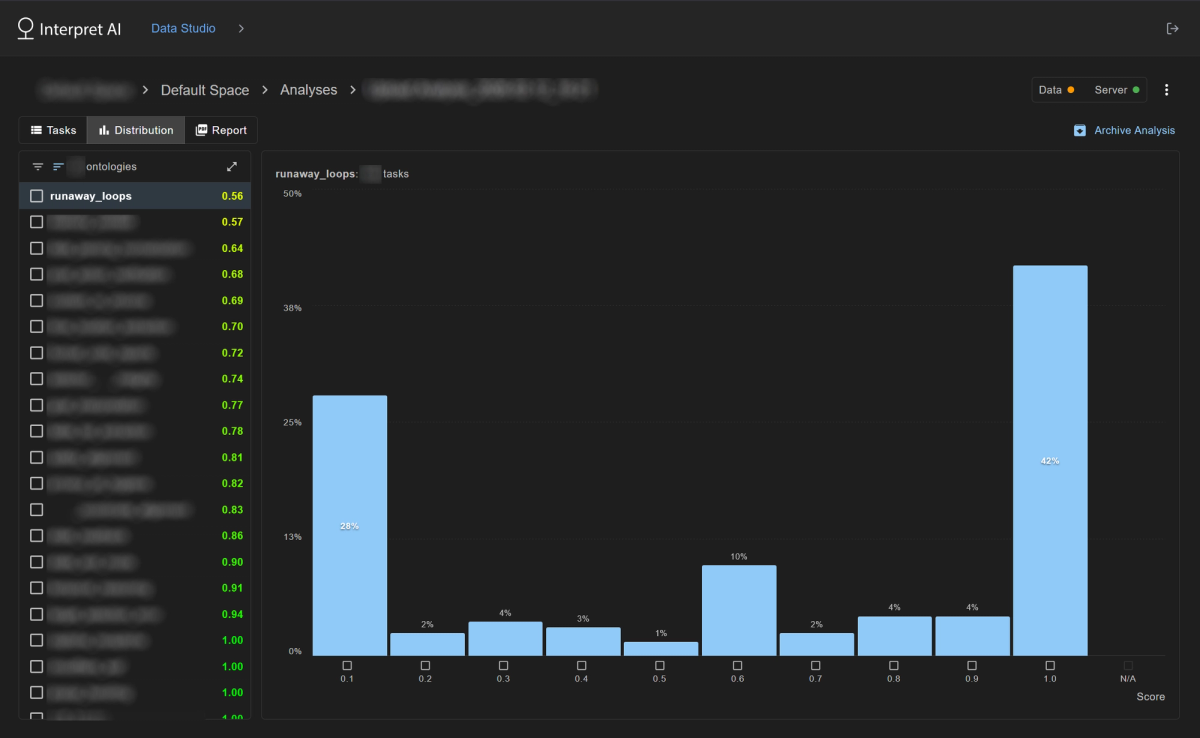
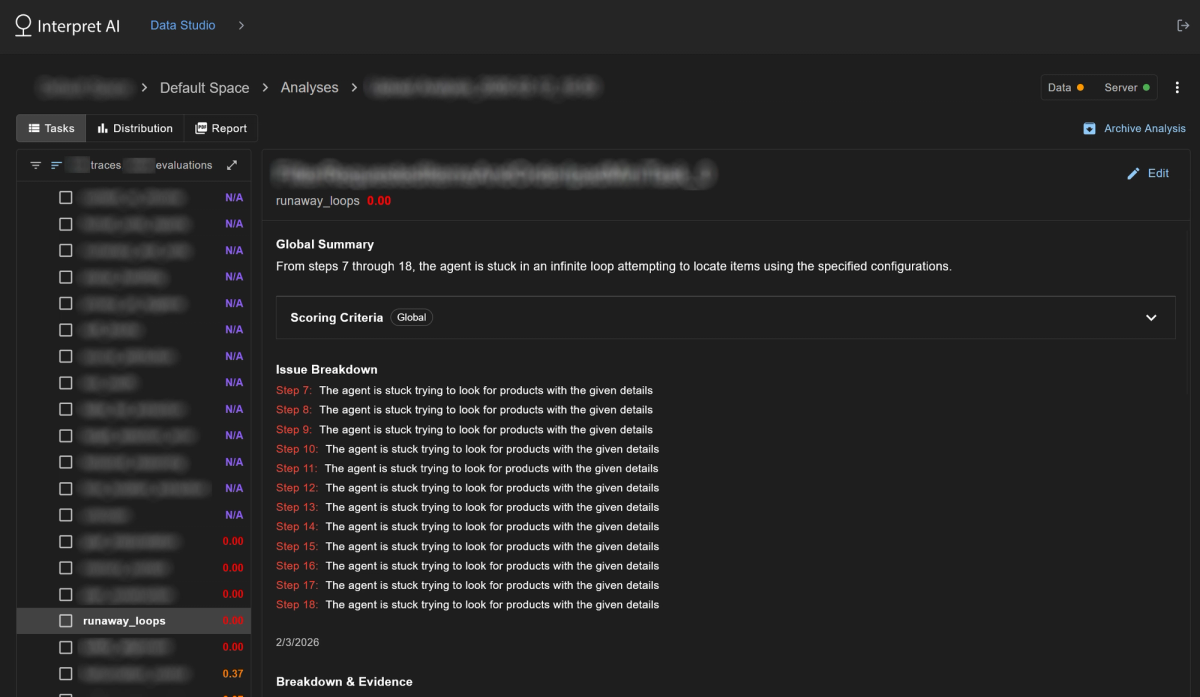
The resulting report looks like the following example in Figure 2, representing an agent unable to progress because they got stuck in a loop of actions. The model has identified the exact steps where the agent repeated a previous action.
The Business Impact
For Silverstream, the value isn't just in knowing what or why something failed, but in the ability to systematically fix it without breaking everything else. By leveraging our Root Cause Analysis, Silverstream shortened the sales cycle from demos to reliable agentic automation.
Silverstream leveraged the Interpret AI analysis to drive agentic success rate to 95%, here is a summary of the 3 key learnings from their experience:
In AI, debugging means building targeted "Golden" Evaluation Sets. While in traditional software developers write a unit test for a bug, in agentic AI you have to use the entire failure cluster as a new Targeted Evaluation Dataset. For example, when Interpret AI identified a cluster of "asynchronous button failures" (where the agent clicked before the UI was ready), we didn't just fix one script. We exported those failed trajectories into a permanent benchmark. Now, every new model candidate must pass this "Asynchronous Interaction" exam before deployment, ensuring their agent will never regress on this specific behavior again.
In order to move fast, get to the bottom of the problem. Have immediate insights on what’s affecting your agentic pipeline immediately. By designing our system to operate at any granularity (from coarsely analyzing failures across ontologies to finely examining why one specific trajectory failed), finding the fix to improve your model is accelerated.
De-Risk your deployment. Previously, shipping a new agent felt like a gamble. Now, by using our RCA reports and automated clustering, Silverstream’s agents are fully auditable. This confidence allowed Silverstream to speed up the phase from customer tailored demo to a provably reliable product.
Word from the Leaders
"Reliability is our entire focus. Interpret AI's platform is indispensable. It gives us the ability to understand agentic behavior at scale. We need to run thousands of agents and understand each one trace at the same time: clustering failure modes, and systematically analyzing what happened is the only way to build the most robust agent infrastructure on the market."
Manuel Del Verme, Silverstream AI CEO
Are Your AI Agents Failing?
Don't sift through millions of logs. Visualize, find, and fix your AI failures at the data level.